
#1 The Scale-Up Conundrum
Knowbrainer is our monthly edition on new ways of working. Each edition features real businesses and research that show how human-centric systems drive growth and innovation. Well-researched, analytical, grounded, not a sales pitch, or a set of prescriptions. A look at management strategies and practices that have succeeded, with a closing thought on what it means through a Simpliwise lens.
In this edition: The Scale-Up Conundrum, or why 78% of companies stall after achieving product-market fit
There is now enough data to treat the scale-up stall as a pattern, and not an exception.
McKinsey & Company, after analysing over 3,000 Series A companies, finds that 78% of businesses that achieve product–market fit fail to scale. The failure rarely looks like collapse; it shows up as a plateau. Momentum slows, execution becomes uneven, and the organisation begins to generate friction instead of efficiency.
The instinctive explanation is strategic because markets shift, competition intensifies, and sometimes, timing falters. But the consistency of the pattern suggests something else, that the constraint is not primarily strategic, but organisational.
McKinsey’s diagnosis points in this direction. What enabled early success, factors such as speed, informality, and founder proximity to every decision, does not translate at scale. Growth requires a shift towards more structured, system-led ways of operating.
In the early stages of a company, three conditions are almost always present.
First, there is clarity. Priorities are visible because the founder is present in decisions, conversations, and trade-offs. People know what matters.
Second, there is speed. Trust is implicit in a small team where individuals are known, and coordination costs are low.
Third, there is ownership. Business outcomes feel personal and there is little distance between action and consequence.
These are not cultural by-products. They are operating conditions. However, as the organisation grows, these conditions begin to erode.
Clarity weakens when alignment is no longer transmitted through proximity to the founder. Speed reduces as coordination increases and decision-making becomes layered. And ownership diffuses as responsibility is distributed across teams and hierarchies.
The organisation may continue to perform, but the system that made performance efficient and compounding is no longer intact. And this is where most scale-up efforts fall short.
The response is typically structural, to introduce new processes, new layers, and new systems. These are necessary too. But they do not, on their own, restore the conditions that enabled high-velocity execution in the first place. The missing step is to fix something more fundamental that will allow companies to navigate the challenging transition from founder-led to system-led.
A-Cube model
The Simpliwise A-Cube model frames these conditions as three attributes necessary for building a system-led organization: Alignment, Autonomy, Accountability.
Alignment ensures that individuals and teams have a shared understanding of direction, priorities, and their role in delivering outcomes. It replaces reliance on founder-led clarity with systems that make intent visible across the organisation.
Autonomy ensures that teams have the agency to act within clearly defined boundaries. It replaces informal, trust-based execution with deliberately designed empowerment. This way, small, accountable units can move faster without losing coherence.
Accountability ensures that ownership is tied to outcomes rather than activity. It creates a direct line between actions and their impact, enabling learning, course correction, and sustained performance.
Individually, each of these matters. In combination, they define how an organisation operates.
When alignment is weak, there is chaos. When autonomy is low, execution slows. When accountability is missing, output suffers.
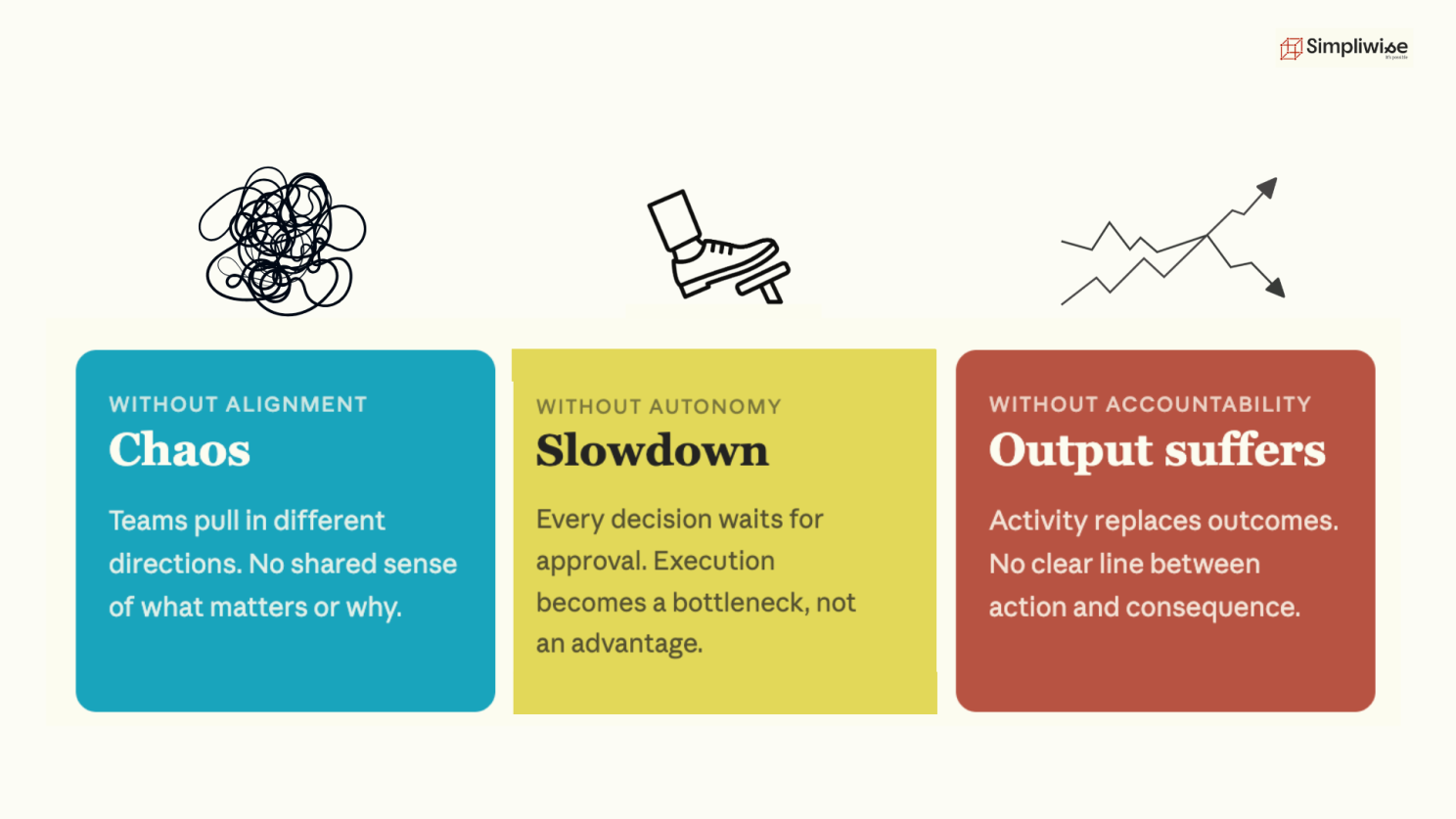
The effectiveness of the system lies in balancing all three.
The companies that scale are the ones that build an operating model in which the teams have the clarity to know what matters, the agency to act on it, and the ownership to care about the result, even if the founder is not in the room.
What did you think of this edition?
If this resonates, we'd like to hear from you. If something we write doesn't match what you're seeing in your organisation, we’d love to hear about that as well.
Write to us at hello@simpliwiseconsulting.com. We read everything.
